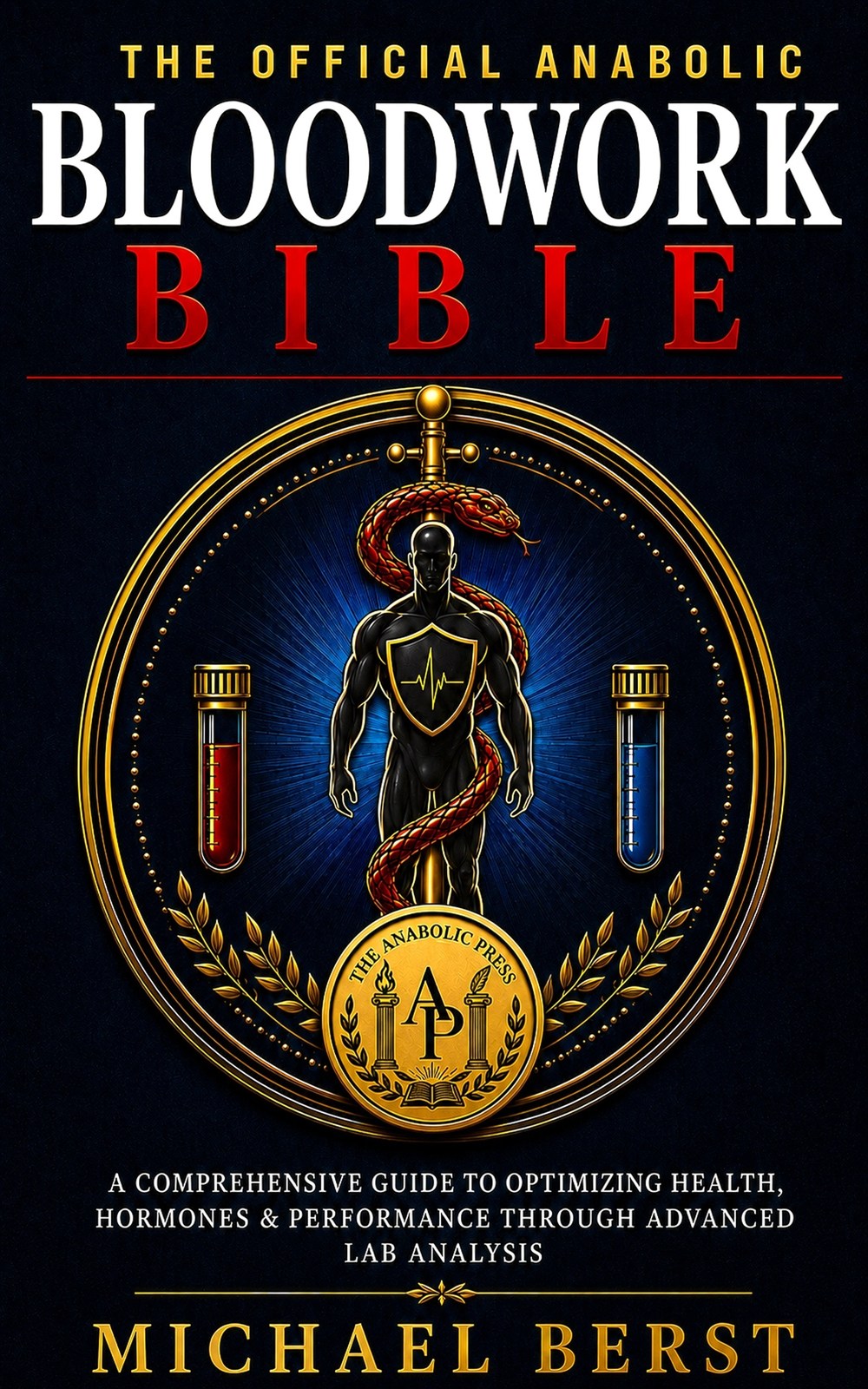
Every panel you've ever pulled has been keeping a record — of your hormones, your heart, your liver, the whole machine. Most people can't read it, so they hand it to a doctor who's never touched a barbell, hear "looks normal," and stay blind. The Official Anabolic Bloodwork Bible is how you learn to read it yourself. 125 chapters. Marker by marker. Compound by compound.
Get The Complete Kit — $59 Just want the book? Professional Edition (PDF + ePub), $39 · or the $9.99 Kindle → on AmazonHere's the trap, and almost everyone's in it.
A standard reference range for testosterone runs roughly 300 to 1,000 ng/dL. That means a man can lose half his natural production — 900 down to 400 — and every lab report still says normal. No flag. No phone call. The system is comparing him to every man who ever walked into that lab, not to himself six months ago.
Now stack the parts of the panel that carry the most long-term risk — the ones that quietly decide how this ends — and notice what they have in common:
Feeling fine isn't evidence. It's the absence of evidence. And the forums won't save you here — that's bro-science divided by two, rounded to a guess.
Reading your own labs is a skill, not a gift. Every marker measures something specific, moves for specific reasons, and has a specific point where "keep an eye on it" becomes "act today." Learn those, and the printout stops being a foreign language written about a stranger. It becomes a status report — on you, addressed to you.
That's the entire job of this book. Not motivation. Not fear. The working knowledge to sit across from any lab result and know exactly what your body is telling you — and what to do next.
Most "bloodwork guides" are a glossary — a list of markers with a sentence each. This isn't that. It's built in three parts because understanding a result takes three questions answered in order: What is this number? What moved it? What do I do?
Every marker on the panel, one chapter at a time: what it measures, why it matters under a hormonal or performance protocol, what drives it out of range, and how to read it in context. Not just the basic panel — the full picture: CBC down to MCV/MCH/RDW, the complete cardiovascular workup (ApoB, Lp(a), hs-CRP, even CAC score and carotid plaque), kidney, urinalysis, liver, and the entire hormone axis — testosterone, free T, SHBG, estradiol, LH/FSH, thyroid, IGF-1, PSA and more.
A chapter for each compound, mapping exactly which markers it shifts, in which direction, and how hard. An out-of-range number stops being a mystery and starts having a suspect. Starting a new compound, or trying to pin an abnormal result on the right agent in your stack? This is the section.
Testing schedules — baseline, on-cycle, long-term. Decision flowcharts for the most common bad results — elevated hematocrit, wrecked lipids, high blood pressure, liver and kidney flags, estradiol problems, fertility. And the cross-reference tables — compound→marker and marker→compound — you keep open at every single draw.
Somewhere in Part III is a chapter the book itself calls the most important one in it: the master triage flowchart. It answers the single scariest question in this entire pursuit — "I have a bad result and I don't know what to do."
Flag in hand, you find the marker, follow the tree, and it routes you: what it likely means, which compound in your stack is the probable cause, how urgent it is, and the next concrete move. That's the difference between a 2 a.m. spiral through forum threads and a calm, ordered answer. That chapter is why this is a reference you use, not a book you read once and shelve.
Not for you if you want dosing protocols or a shopping list. This book is about reading your body, not chemically programming it.
The Bloodwork Bible (Professional Edition: searchable PDF + ePub) plus all five companion tools — the Pre-Cycle Checklist, GLP Lifter's Cheat Sheet, 10 Natty Commandments, Anavar Quick-Reference, and Anavar for Women card — plus free lifetime updates and a founding-reader discount on the next title. Everything the Press has made, in one download.
Searchable PDF + ePub, instant delivery, free lifetime updates. The complete 125-chapter reference, nothing else attached.
Also on Amazon: Kindle $9.99 · Paperback $34.99 → find it on Amazon. The Kindle's a great reading copy. The direct editions are the working copy — searchable, dual-format, and they keep updating.
The next lab report is coming whether you can read it or not. You paid for the test. Learn to own the results.
The strongest move is always the informed one.